







 In a little over two years, Genie has gone from a Public Preview feature for asking questions of your data in plain English, to the main way Databricks wants business users to work with the platform. September's releases show where it's going next: the Excel Add-in and the Genie One MCP server both went GA, and at the end of the month Databricks bought Row Zero, a spreadsheet company, to build into Genie.
In this post, I'll walk through how Genie got here, then look at what Databricks' plans mean for organisations already running on Databricks.
Two years of Genie
The timeline below covers the main steps, with a bit of context on each.
📅 June 2024: Databricks launched AI/BI, with Dashboards going GA and Genie going into Public Preview as a way for anyone in the business to ask questions of their data in plain English. Genie writes SQL against your tables in Unity Catalog, so the quality of its answers has always depended on the metadata behind them.
📅 June 2025: Genie went GA, and Databricks announced Databricks One as a code-free home for business users. A week later, managed MCP servers arrived in Beta, including one for Genie spaces, so other agents could ask Genie questions with each user's Unity Catalog permissions applied.
📅 April 2026: Databricks renamed Databricks One to Genie and moved it to the account level, so it no longer sits inside a single workspace. In the announcement, Databricks said Genie was becoming the main way people use the platform.
📅 June 2026: At Data + AI Summit, Genie One, Genie Agents and Genie Code went GA. Databricks also introduced Genie Ontology to hold business context, such as metric definitions and how things relate, and announced Genie App Builder.
📅 July 2026: Genie spaces were renamed Genie Agents, and Microsoft extended its Databricks partnership into the 2030s, including bringing Genie into Microsoft 365, Teams and Copilot.
📅 September 2026: The Excel Add-in went GA on the 10th, Genie One opened to people without a workspace on the 16th (in Beta), the Genie One MCP server went GA on the 22nd and Genie App Builder entered Beta on the 23rd. On the 24th, Databricks bought Row Zero.
What Databricks is aiming for
Databricks has been fairly open about this. It launched Genie One in June as an AI coworker for business teams, and Ali Ghodsi said "most enterprise AI today is just guessing with false confidence", putting that down to missing business context. He also said he wants every business leader to have Genie to hand.
My reading of the announcements is that Databricks wants the business context (Genie Ontology) and the permissions (Unity Catalog) to live in one place, and it's happy for people to reach them through whichever tool they already use, including tools Databricks doesn't make.
That matters because, for most business users, Databricks has been something they meet second-hand, through a Power BI report or an extract someone has sent them. Genie gives them a direct way in, and Databricks is putting that way in wherever they already spend their day, partly by working with Microsoft on Microsoft 365 and Teams, and partly by building its own experiences, such as Genie One and now Row Zero.
The MCP server is the clearest example of that flexibility. Databricks is openly supporting other companies' assistants as a way into its data, which tells you it's comfortable with Claude or ChatGPT being the screen someone uses, provided the answer comes from Genie and respects Unity Catalog.
Genie where people already work
Business users can already reach Genie, or the governed data behind it, from quite a few places.
-
Genie One. The main home for business users, available on web and mobile, with a desktop app for macOS in Beta. Since 16 September, people who aren't assigned to a workspace can use it too (also in Beta), and Unity Catalog still decides what each person can see. That matters in organisations where most staff have never had a Databricks login.
-
Microsoft 365 and Slack. The July partnership includes bringing Genie into Microsoft 365, Teams and Copilot, and a Genie app for Teams is already in Public Preview. There's a Genie app for Slack too, and since September its replies can include charts (also in Public Preview).
-
Excel. The Excel Add-in, GA since 10 September, lets people pull governed Unity Catalog tables into Excel and write results back. Pivot tables can also run as live queries, so the numbers update as people change the fields.
-
Claude, ChatGPT and other agents. The Genie One MCP server, GA since 22 September, lets any MCP client (Claude, ChatGPT and Cursor, for example) ask Genie questions, with Unity Catalog permissions enforced on every request. If you set up the Beta endpoint, it's being retired on 31 October, so move to the GA version before then.
-
Apps. Genie App Builder, in Beta since 23 September, builds apps from a prompt inside an App Space that enforces governance, and the apps scale to zero when nobody's using them. Ashley's post on production-ready Databricks Apps covers the engineering side.
Why Row Zero
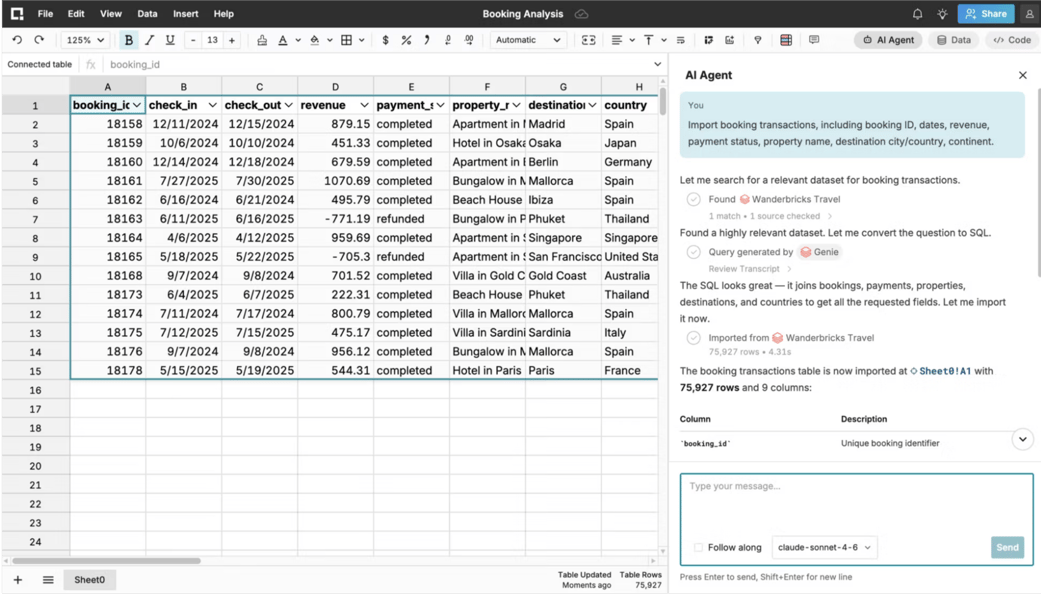
Row Zero applies the same thinking to spreadsheets, which are still where most business analysis happens. Every export loses the permissions and lineage you had in Unity Catalog, and the copy starts going out of date as soon as it's saved (the Excel Add-in covers anyone who'd rather stay in Excel).
According to Ghodsi's post on X, Databricks' own finance team was already using Genie and Row Zero together before the deal. Today that connection starts in Row Zero: you ask a question, Row Zero passes it to Genie, and the results come back as a connected table built on the semantic layer you've set up in Databricks. From there you carry on with pivots and formulas, or ask Row Zero's own agent to build them (Row Zero's post walks through it).
Databricks' announcement says the plan is to turn that around, so you start in Genie and open an answer as a live spreadsheet without leaving Databricks. Queries will run with each person's permissions, data will refresh from the source, exports can be locked down and results can be written back, all on Row Zero's own engine (which Databricks says handles billions of rows at interactive speed). There's no date for it yet.
What this means for your organisation
For business users, the change is being able to ask questions of your Databricks data from the tools you already use, with the same permissions applied wherever you ask.
For data teams, more of the work moves to the definitions underneath. Every route above reads the same metric views and table descriptions, and Databricks says Genie gives higher-trust sources priority when it decides where to look, so certifying the right tables and writing descriptions a business user would understand now affects answers in every tool at once. Ust's post on Genie as a semantic layer problem and Toyosi's on what AI agents expose in your data platform go into this properly, so I won't repeat them here.
For data leaders, a sensible place to start is one team and the handful of questions they ask every week. Get the metrics behind those questions into metric views, and use Genie's benchmarks to check the answers before you roll it out further.
What's still unclear
A few things aren't settled yet. The native Row Zero experience has no date, and Databricks hasn't shown it running inside Genie.
The naming has also moved quickly. Databricks Assistant became Genie Code in March, Databricks One became Genie in April and Genie One in June, and Genie spaces became Genie Agents in July, so if you've written internal guides for any of these, they probably need a refresh.
The MCP server has also only just gone GA. Unity Gateway gives you policies and audit logs for every call, but deciding which outside agents should be able to reach Genie in the first place is new ground for most teams.
Conclusion
Genie started as a way to ask questions of a few tables in plain English. Two years later, it's how Databricks wants business users to work with the platform, and September's releases take it into the tools those users already have open. For organisations on Databricks, the practical work is getting the definitions and permissions underneath ready for that.
If you're planning a Genie rollout and want help getting your semantic layer ready for it, get in touch.
Further reading
- Genie Is a Semantic Layer Problem, Not a Chat Problem by Ust Oldfield, on why the quality of Genie's answers comes down to the semantic layer underneath.
- How Databricks Genie Agents aims to move from BI to Business Automation by Toyosi Babayeju, on what Genie Agents add beyond answering questions.
- Databricks Genie ZeroOps: Your Self-Healing Agent? by George Dutton, on another of the Genie announcements from Summit.
- Databricks on the next generation of Genie, Databricks' own account of where Genie is heading.
- From query to analysis: Using AI in Row Zero, Row Zero's walkthrough of the current Genie integration.
