





We’re building more apps than ever before
During day 2 of the Data + AI Summit, a stat was shared that blew my mind. The IBC expects that 1 billion new custom applications will be developed by 2028. 1 billion! This would mean that more applications will be developed over the next 2+ years than in the last 40 years. And the scariest part is that most of them will be developed by citizen developers using agentic coding tools.
It raises the question: how can we ensure that those citizen developers are building apps that are production ready, well governed, secure, and built within a reasonable budget? Databricks expressed these concerns with this slide, breaking them down into 3 core challenges:
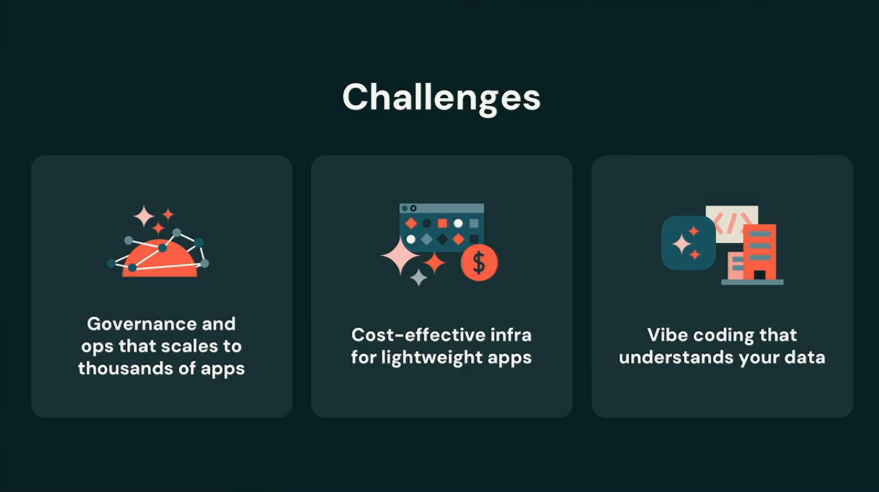
They then proceeded to announce three new offerings, one to solve each of these challenges. Between them, they will help you to both develop faster than ever before, but also do it in a way that is safe and that won’t break the bank. These three features were:
- App Spaces, which will help you govern and operate the apps being built;
- Serverless Micro Apps, which will let you effectively scale your apps down when they aren’t being used heavily; and most excitingly:
- Genie App Builder, that will help you vibe code Databricks Apps connected to your data with a tool that understands your business.
I'm super excited about these tools and what they'll enable us all to build and, more importantly, make production ready! In the rest of this blog, I am going to break down each of these features and explain why they are so needed.
Governing app creation with App Spaces
In my opinion, the key theme of the entire conference, across all the different personas, products and disciplines it covers, is that governance is cool again! As the number of apps starts to explode, we need to start thinking about how we plan to govern and operate them at scale. App Spaces is Databricks' attempt at giving you the tools to do just that within their environment.
Think of an App Space as a workspace for apps. Your workspace admins setup a series of policies that will apply to every app within the space. You define the resources, both internal to Databricks and externally, that the apps can interact with, and their access to data. You can enforce authorisations and permissions for who can interact with the apps, and in what way (including enforcing “on-behalf-of-user” access,) and design the security policies that you want your apps to follow. You can even set budgets that the builders and users will need to stick to, and then track the cost and usage of apps deployed to the space.
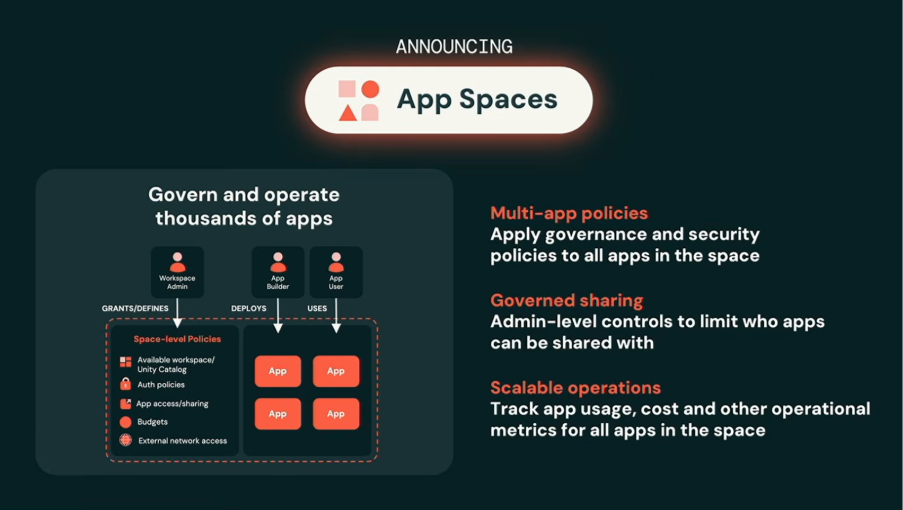
Think of this as setting guardrails that anyone building or using an app must follow. To quote Databricks’ blog on the release, “this shifts governance from reactive to systematic”. Builders gain the autonomy to build whatever they need, and can do so without needing the admins to be looking over their shoulders and reigning them in on a case-by-case basis – the governance is already there, and what you can and can’t do is pre-approved. The admins don’t have to worry about a rogue new app, and no longer act as a bottleneck for getting apps into production
Your builders and users are free to do what they do best, innovating and driving your business forward, without placing a burden on your admins to control and safeguard!
Serverless micro apps: because not every app needs 'always on' infrastructure
Not every app that is built is going to have a consistently high usage. It’s analogous to analytical products – not every dashboard or dataset gets used every day. But that’s OK; an app that is used once a month by two users can still provide enough business value to justify its existence.
What isn’t OK is having to pay for the app to be always on and always available, even when it hasn’t been used for a week and won’t be for another. That had been my biggest gripe with Databricks apps; that if you wanted your app to be available for your users, it had to be always on, even when it had 0 users, and you had to pay for that privilege. Also, that the minimum size was medium, comparable to 2 vCPUs, even if your application was tiny.
Both of these will no longer be an issue with Serverless Micro Apps.
Serverless Micro Apps are built on “micro-VMs” which means they can be configured to be small and to scale down to zero when they aren’t in use. Traditionally this hasn’t been possible, as the cold-start times when users did log back into the app were too long, but because these micro apps run on lightweight VMs, they can spin up much faster. If a micro app isn’t being used, no problem. It will scale to zero and won’t cost you anything.
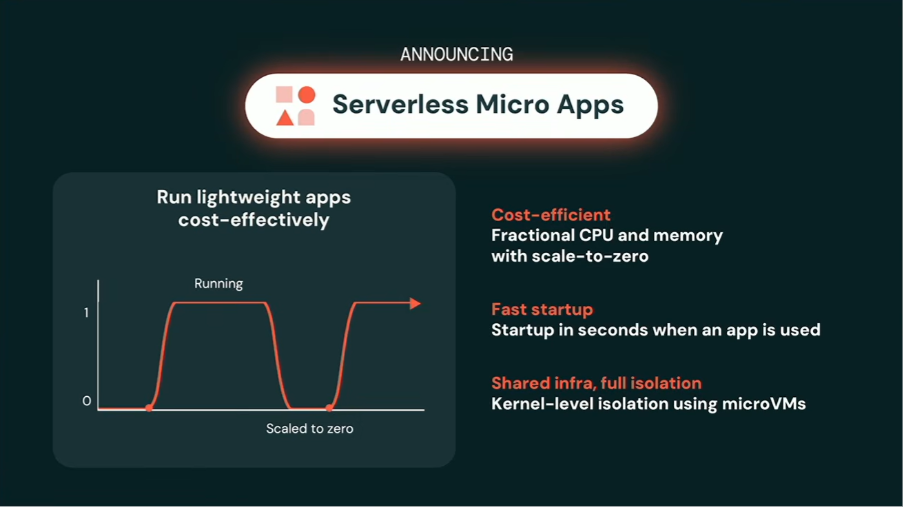 Ultimately this means that the apps that might not have been built in the past, because they weren’t economically viable with always on reserved capacity pricing, can now be built, deployed and drive value for your business.
As a former accountant, I expect to see a series of apps to aid finance teams with month end reporting springing up at every business any day soon!
Good vibes only with Genie App Builder
So now we can govern and operate whatever people are building. But how do we support builders in creating apps that can connect and use their data without them needing to be a coding expert? Enter Genie App Builder!
 The suite of Genie based products massively expanded at Summit, and the capability of the Genie products also drastically improved, thanks to one of the biggest announcements at Summit, Genie Ontology. Ultimately Genie Ontology gathers all of your business context from your Databricks estate (and connected apps) and uses to it to provide the various other Genie products with a crash course on your business. Then, when you ask Genie about a concept that only exists within the realm of your business, it knows what you mean.
That is incredibly powerful when you are building apps. If you were using Claude Code (or Codex, Loveable, Cursor or another agentic tool) to build an app, and you wanted to display a metric you derive using logic over the top of a table in your Databricks estate, you would likely have to provide an explanation of each of those things. If you wanted to reuse concepts from a different app, you’d have to provide the codebase, or hope it vibed up something similar. With access to Genie Ontology, Genie App Builder should be able to just do it, with no need for you to provide extra explanation. Also, if that data is inside Databricks and you have access to it via your App Space already, then you can just leverage it automatically with no extra steps.
All in all, that should make building an app easier and faster than it ever was before!
The future is App-gentic
If you haven’t watched the keynote demo of this trio of announcements in action, then I would highly recommend you give it a shot. I’d also suggest you check out the announcement blog from Databricks next.
All three of these capabilities are currently in Private Preview and will hopefully land soon. When they do, I think they are going to revolutionise the way we build, govern and operate apps within the Databricks ecosystem. I am super excited to see what problems business users will solve with apps, given that building them can now be as simple as some instructions and hitting some buttons.
This feels like an exciting new frontier. And it’s never been more accessible!