



This is part 3 of 3 in our Disability Pride Month series. "Disability Pride Month 2026: Where did it all begin?" looked at where Disability Pride came from; "Disability Pride Month 2026: The Dropped Kerb Effect" looked at how far things have come — dropped kerbs, built for wheelchair users, now used by everyone from cyclists to parents with prams. This final part attempts to look at what's next: not just tools, but disabled people leading.
I'm a Principal Consultant. I also have multiple sclerosis, and some days that means planning my abilities the way I'd plan a project — knowing roughly what I have to spend, and what happens if I overrun. Because I work remotely, plenty of colleagues and clients don't know I have MS until we meet in person for the first time and they notice I walk with a crutch. That moment — watching someone recalibrate what they assumed about me — happens more often than you'd think, and it's part of why I wanted to write this.
One of Advancing's key values is "Come as you are." This post is my attempt to actually do that, rather than just say it.
The gap we don't talk about
Here's a statistic that stopped me when I first read it: From a 2025 report, there was only one executive or senior manager across the entire FTSE 100 that has disclosed a disability. [1] Separately, around 7% of C-suite leaders across 17 countries have lived experience of disability — but roughly four in five of them have chosen not to say so. [2]
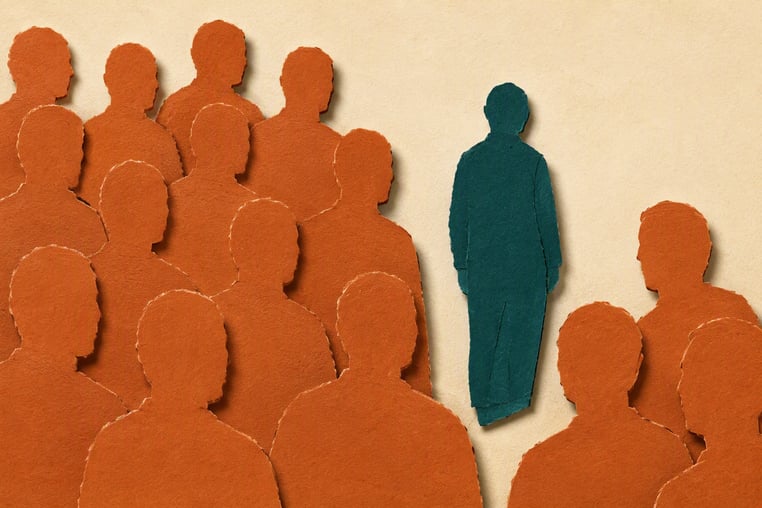 That gap tells you something important: this isn't a pipeline problem. Disabled leaders already exist, in senior roles, right now. What's missing is disclosure — and visibility. 91% of organisations surveyed say having a visible, senior disability champion is essential to making inclusion work. [3] You can't be what you can't see, and right now, most of us can't see much.
I spent a number of years on the wrong side of that gap myself. When I was diagnosed in 2011, I wasn't in data at all — I was a couple of years out of university, playing music, with no real sense yet of what I'd end up doing with my career. My first symptoms were foot drop and increasing clumsiness when walking, and by the time I had a diagnosis, I'd already spent months feeling infantilised, and quietly terrified about what it meant for my future — career, relationships, everything.
Why career progression is so challenging for disabled people
The job I had at the time — a temp role at an insurance company — showed me exactly what doesn't work. My manager didn't understand MS at all, at one point confusing it with a completely different condition. What they did understand was my sickness record, and they were concerned about it. I didn't get support; I got scrutiny. I wanted to keep my diagnosis private for as long as I could, and in the end it wasn't really my choice — colleagues noticed the bathroom breaks and the limp before I'd decided how or when to tell anyone.
Consultancy can have its own version of this problem: an "always-on" culture built around billability, travel, and constant availability. None of that was designed with a fluctuating condition in mind. If we want disabled people to reach and stay in leadership, the fix isn't complicated — it's letting people manage their own time, and treating their recovery as part of job flexibility rather than a deviation from it.
What actually changes this is people, not policy documents. More recently in my career I've had a line manager, who I felt was consistently in my corner — including during difficult project outcomes, when it would have been easier not to be. Disability can be isolating in a way that's hard to describe unless you've felt it; having someone actively advocating for you is one of the most empowering things I've experienced in my career. It's one of the reasons that I believe that an advocate/mentor provides a massive boost to success.
Leading differently, not despite
I don't think my leadership style is good despite having MS. I think parts of it are good because of it. Managing a condition that doesn't ask permission before it shows up has made me far more compassionate about what other people might be carrying - especially in an industry as demanding and competitive as consultancy, where it's easy to assume everyone's baseline capacity is the same. It isn't. I plan around constraints as a matter of habit, and that instinct turns out to be useful leadership, not just a personal accommodation.
I'm not the only one making this case. Chuck Edward, who leads HR for a large part of Microsoft's cloud and AI organisation, has spoken publicly about disclosing his own MS diagnosis at work — describing it not as a weakness to manage around, but as something that changed how he leads. [3]
What's next - AI, the new dropped kerb?

If Part 2 of this series was about the dropped kerb, this is its future-facing sibling — and AI looks like the next generation of the same effect. Tools that can be used to reduce the cost of a disability are quietly becoming everyone's productivity tools: live captioning, voice-to-text, meeting summarisation, AI-generated image descriptions, predictive text for people with motor or speech impairments. For someone managing a fluctuating condition, this matters directly — every task an AI assistant can absorb is energy I get to spend somewhere else. I use tools like this fairly frequently and find it exceptionally useful to avoid missing information. It also provides a captured log of decisions which I can reference for further decision making.
Sometimes when I travel for a client meeting or a community event, an unfamiliar city used to mean standing on a corner trying to hail a cab, or navigating a subway network that would delay me from where I actually needed to be. Being able to open an app and have a car sent straight to my exact location has made that whole part of travelling easier — not a dramatic accessibility win, but one less thing between me and the actual reason I'm there.
None of this is unconditionally good, and a leadership piece should say so plainly. AI tools inherit the bias in the data and assumptions behind them — hiring algorithms have already been shown to disadvantage disabled candidates [4] — and "AI accommodation" can become an excuse to avoid the harder, human work of actual policy change. The tools themselves aren't always accessible either: an AI interface that isn't screen-reader-friendly or voice-navigable just moves the barrier rather than removing it.
Leadership already exists — it just needs to grow
Disabled leadership isn't a future hope; it already exists in all fields. Temple Grandin built her authority in animal science - as a professor at Colorado State University she designed the livestock-handling systems now used across roughly half of North America's cattle industry, and she consults to that industry worldwide. Closer to home, David Blunkett became the UK's first blind Cabinet minister, holding the Home Office, education, and work and pensions positions across three decades in government — proof that a disability doesn't have to define, or limit, the portfolio someone is trusted with. Also Baroness Tanni Grey-Thompson, an eleven-time Paralympic gold medallist, now sits on the boards of UK Athletics and Transport for London and has chaired 'ukactive' governance roles built on sporting and transport expertise.
None of this was easy, and none of it looked like it would lay the foundation for some future inspirational speech. It was just their work and willpower.
What would we like to see by the next Disability Pride Month?
If there's one thing I want a disabled graduate or junior consultant to take from this series, it's this: you don't have to feel limited. A successful career doesn't only belong to extroverted people with unlimited energy and a packed travel schedule. Mentoring structures exist to help people grow these roles — not despite their limitations, but often because of what navigating them teaches.
We started this series with history, moved through the present, and I want to add this to it: the future of Disability Pride isn't just a more accessible world.
It's disabled people at the front of the room, deciding what that world looks like next.
[1] - New ActionAble 2025 insight reveals FTSE 100 Falls Short in Disability Inclusion
[2] - Disability absent from leadership strategy in majority of global businesses. - Valuable 500
[3] - A high-profile leader reveals his disability to help others have a more empowered voice - Source