





loader

Intelligent Document Processing Accelerator

Turn business critical documents into trusted structured data you can act on

Uses AI to read, sort and extract the information that matters, identify risks, obligations and renewals early, and gives decision-makers clear, traceable evidence to support every action. 
A plain-English question returning three supplier contracts that renew soon (sample data)

Up to

90%

less handling time

Up to

10x

faster operations


Lower

cost of manual processing at scale

 

Databricks

Built on Azure Databricks

Your documents hold the answers. Getting to them takes too long.

Business-critical information is often locked inside contracts, claims, applications and reports, leaving teams reliant on manual processes to access and act on it.

An estimated

$2 trillion

is lost every year worldwide through missed obligations, overlooked renewals and inefficient processes.
Source

Expired agreements
Unwanted auto-renewals
Inconsistent contract language
Regulatory exposure
Slower onboarding, approvals, claims and invoices

What is the
Intelligent Document Processing Accelerator?

What is the
Intelligent Document Processing Accelerator?

The Intelligent Document Processing (IDP) Accelerator reads, sorts and extracts the information that matters from contracts, claims, invoices, forms, emails and reports, checks every answer and shows where it came from, so the results can safely drive automation, reporting and AI.

Your documents

ContractsClaimsInvoicesFormsEmailsReports

The IDP Accelerator

Reads, sorts and extracts the information that matters
Checks every answer and shows where it came from

Results that safely drive

Automation
Reporting
AI
  • “What have we committed to, and when?” Asked by Legal, Procurement and Contract Management
  • “Can we evidence compliance?” Asked by Risk, Internal Audit, Data Protection and Information Security
  • “Where is spend leaking?” Asked by Finance, Treasury and Procure-to-Pay
  • “What changes in a deal?” Asked by Commercial and Sales Ops
  • “Which version is authoritative?” Asked by Records and Contract Management
  • “When do our SLAs, licences and leases need action?” Asked by Service Delivery, IT, HR, Real Estate and Customer Service

Read

It reads, sorts and extracts the information that matters in seconds.

Outcome

Reduced operational cost

Automating how documents are taken in, sorted and read

Prove it

It reports and checks every answer, identifying risks, obligations and renewals ahead of time.

Outcome

Fewer errors, less risk

Automatic checks, confidence scores and a human review of anything uncertain with every answer being traced back to its source.

Act

Respond faster to customers and stakeholders with proof that backs up every decision.

Outcome

Improved service

Onboarding, approvals, invoices and claims move in minutes

Getting started is simple

 We've seen skilled teams spend their days on exports, filing and data entry instead of judgement. So we start small and prove it first. 

Steps: 1 Book a demo, see it work on sample documents. 2 Run a pilot, try it on part of your own documents. 3 Roll it out, read, prove and act across every document.

✓  A person signs off every decision that matters✓  Every step auditable✓  Reads documents where they sit✓  Built to extend, not rebuilt
Book a demo

What our document
automation has delivered

Two distinct use cases for a specialty insurer, both on the Databricks Data Intelligence Platform, with a person on every decision.

Specialty insurerIn production

Sanctions screening

~10x faster screening, from hours to minutes

Live across underwriting, claims and finance, with an audit trail of who screened what and what was decided.

How we did it

Challenge: Every check meant manual provider queries, exports, filing and summary emails.

Approach: Screening calls, exports and filing automated. Summary emails drafted. A review panel makes the final call on any match.

Specialty insurerDelivered

Claims triage and correspondence

~90% less handling time per low-value claim

About 2 minutes per claim, down from 15 to 20. The handler approves every email before it goes.

How we did it

Challenge: Claim details arrived scattered across emails, PDFs and systems. Skilled handlers spent their days on triage and data entry.

Approach: A small team of narrow agents for intake, triage and correspondence, with the handler in charge of every decision.
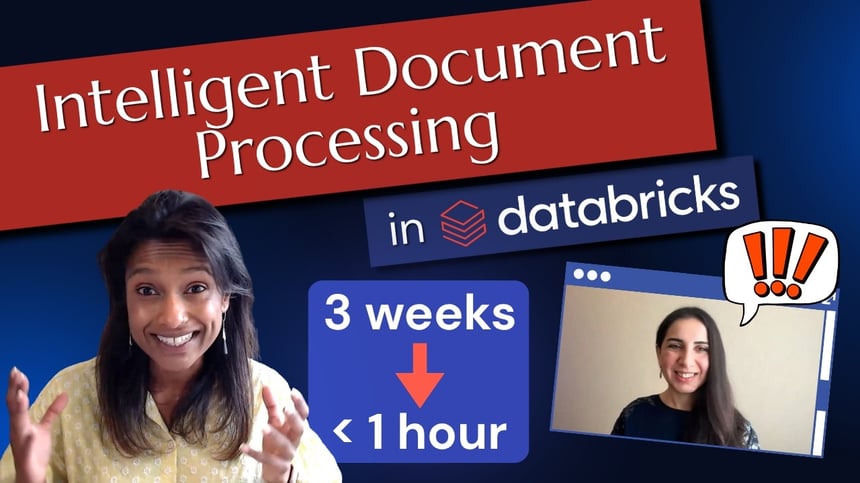


Watch & Read  See it in action, and go deeper on document intelligence.

FAQ

What is intelligent document processing?

Intelligent document processing (IDP) uses AI to read, sort and extract the information that matters from contracts, claims, invoices, forms, emails and reports. It checks every answer and shows where it came from, so the results can safely drive automation, reporting and AI.

How does intelligent document data extraction work?

Documents are picked up from where they already sit and classified. The information that matters is extracted, cross-checked and given a confidence score, and a person reviews anything uncertain. The structured data then feeds automation, reporting and AI.

What type of documents can be extracted?

Most business documents, digital or scanned: PDFs, Word files and spreadsheets, as well as emails, chat logs and meeting transcripts. Typical examples are contracts, claims, applications, invoices, forms and reports. If you have something more specialised, such as engineering drawings, medical records or images, talk to us and we'll test it on your documents first.

How does it track renewals and notice periods?

Information including renewal dates, notice periods and legal obligations can be extracted automatically and confidence scored, so upcoming deadlines are visible before they pass.

How is it governed?

A full audit trail is built in: who did what, when, and what was decided. Every answer is traced back to the page it came from, access is controlled, and a person reviews anything uncertain.

Where do our documents stay?

Documents are read from where they already sit, and processed on Databricks under your existing access controls. Before a pilot starts, we confirm with you which region each processing step runs in, so it meets your data residency requirements.

What does a pilot involve?

Our forward deployed engineers, who specialise in taking AI into production, work alongside your team on your own documents. Together we agree which information matters to your business and what it should drive next, such as a renewal alert, a claims decision or a report. We set up the Intelligent Document Processing accelerator, run it on a representative sample of your documents, and measure the results against answers your team has checked. You come away with data you can act on, real figures for accuracy and cost, and a clear plan for going into production.


Ask your documents a question.

See answers come back in seconds, each one traced back to the page it came from.


James Lowson
James Lowson
Senior Account Exec
James Lowson
Senior Account Exec

Passionate about helping clients cut through the noise and find solutions that actually move the needle.

cem
Cem
Chief Architect
Cem
Chief Architect

Resident expert in modern data platforms, cloud architecture and enterprise-scale solutions.

DSC07502
Lucas
Head of GTM
Lucas
Head of GTM

Relationship‑driven leader, recognised for helping clients succeed and teams win together.

Emma
Strategic Account Director
Emma
Strategic Account Director

Strategic account director and FS SME driving data-led growth, partnerships, and client success.