






If your GenAI programme is a chat tab people copy and paste into, you haven’t changed the work. You’ve added a step. That step is the tax: switching screens, rewriting, checking, and then typing it all back into the system that actually runs the job.
That "extra step" was cool at first, now its everywhere and annoying. In insurance, it becomes a problem fast. You’re making regulated decisions from messy evidence, on top of old cores, with customers who escalate the second something feels unfair. A chat helper on the side doesn’t hold up for long.
So 2026 is when the pilot era ends. Not because the tech turns into magic, but because budgets, risk teams, and ops stop paying for toys.
Here are my 10 calls for 2026 and what they mean for insurers (retail follows the same logic, but insurance will feel it first).
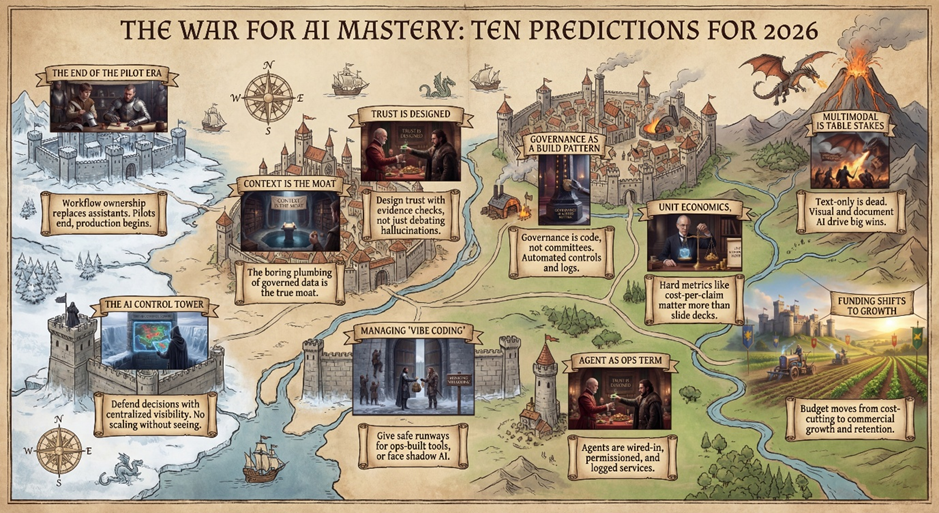
1. Copilots hit a ceiling. Workflow ownership is what matters.
Copilots help people write and summarise. Fine. But they don’t move a claim or a quote.
The pattern that wins is an agent that owns a narrow workflow end-to-end.
- FNOL intake → classify → request missing info → route → create tasks
- Underwriting referral → summarise evidence → compare against appetite → draft broker questions → log decision rationale
In 2026, teams stop paying for “assistants” and pay for workflows with controls.
2. “Agent” becomes an ops term: wired in, permissioned, logged.
The model isn’t the blocker. Integration and control are.
Most failures are dull: wrong permissions, weak tools, brittle exception handling, no audit trail.
If an agent touches claims, payments, declines, fraud flags, or pricing, you need clear answers:
- What systems did it call?
- What data did it use?
- Under whose permission?
- What evidence supports the output?
- Who approved the high-risk step?
In 2026, “agentic” stops meaning “cool demo” and starts meaning “production service”.

3. ROI stops being a slide. It becomes unit economics.
GenAI spend is messy: tokens, retrieval, vector infra, monitoring, humans in the loop. If you can’t tag cost to a workflow, every budget review turns into a fight.
Insurers move to hard unit metrics:
- cost per claim touch avoided
- cost per call deflected
- cycle-time reduction per claim segment
- impact on leakage (or cost to investigate fraud per £ saved)
- underwriting throughput and referral quality
In 2026, programmes that can’t show unit economics get cut. Programmes that can, get rolled out.

4. Every serious insurer builds an AI control tower (or they’re guessing).
You can’t scale what you can’t see. Most failures aren’t one big model mistake. It’s the slow bleed: latency, rework, hidden safety issues, low adoption.
A control tower becomes mandatory because it’s how you defend decisions to risk, audit, and regulators.
Minimum view:
- quality and rework rate
- safety violations and PII incidents
- latency and failure rates
- adoption by role/team
- cost per workflow
In 2026, “we shipped something” becomes “we run it like ops”.

5. Context becomes the moat (and most insurers are behind).
Model capability is converging. The gap is whether your system can pull the right evidence, with the right permissions, and show it cleanly.
Insurance data is fragmented and versioned: policy wordings, endorsements, claim notes, bordereaux, third-party reports, emails.
If your context layer is weak, your agent will:
- quote the wrong wording version
- miss key endorsements
- pull data the user shouldn’t see
- make up rationale
In 2026, the boring plumbing becomes the main work: governed data products, semantics, permissioning, retrieval quality, and eval sets built from real claim chaos.

6. Multimodal stops being a lab project. It becomes table stakes.
Text-only GenAI hits a wall in insurance because the expensive work is visual and document-heavy.
Multimodal is where you get the big wins:
- damage photo severity routing (triage)
- document packs summarised with cited evidence and extracted fields
- fraud signals from mismatches between images, receipts, and narrative
- faster subrogation spotting from packs and correspondence
In 2026, insurers that stay text-only will look busy while competitors remove layers of manual handling.

7. Governance stops being a committee. It becomes a build pattern.

Most governance today is paperwork. It slows delivery and still doesn’t prevent incidents.
In regulated workflows, governance has to be built in:
- decision logs
- versioning (prompt/model/data)
- evidence citations
- access controls
- monitoring and incident response playbooks
In 2026, the fastest teams are the ones with repeatable governance, not bespoke politics.
8. The hallucination argument dies. Trust is designed.
Arguing about hallucinations is like arguing whether software has bugs. Yes. The point is how you design around it.
Mature patterns look like:
- evidence-first answers (show clause, note, doc)
- checks before high-risk actions (declines, fraud flags, payment recommendations)
- thresholds and escalation rules
- continuous evaluation in production, not just pre-go-live tests
In 2026, anything that can’t justify outputs won’t be allowed near customer-facing or decisioning workflows.

9. Vibe coding lands in ops. Manage it or it goes underground.
Claims ops and underwriting support are drowning in admin. They will build helpers. Blocking them just pushes it into shadow AI.
Without guardrails, you get:
- unmanaged spreadsheets acting as decision engines
- copy/paste into public LLMs
- “automation” with zero audit trail
In 2026, winning insurers give people a safe runway:
- approved templates (triage, summarise, draft correspondence)
- locked-down data access and safe tool endpoints
- logging by default
- a clear promotion path from sandbox to production

10. GenAI funding shifts from cost-out to growth and retention.
Cost-out gets you in the room. It also caps fast. The lasting budget shows up when GenAI drives commercial outcomes.
The growth plays that stick:
- faster quote-to-bind without degrading risk control
- better referral decisions (fewer dumb declines, fewer bad accepts)
- broker servicing that removes friction and improves placement
- retention interventions based on meaningful signals
- claims experience improvements that lift NPS without leakage

In 2026, insurers that connect GenAI to growth keep momentum. Everyone else becomes a perpetual pilot factory.